The Ego-Angler On My Side of the River
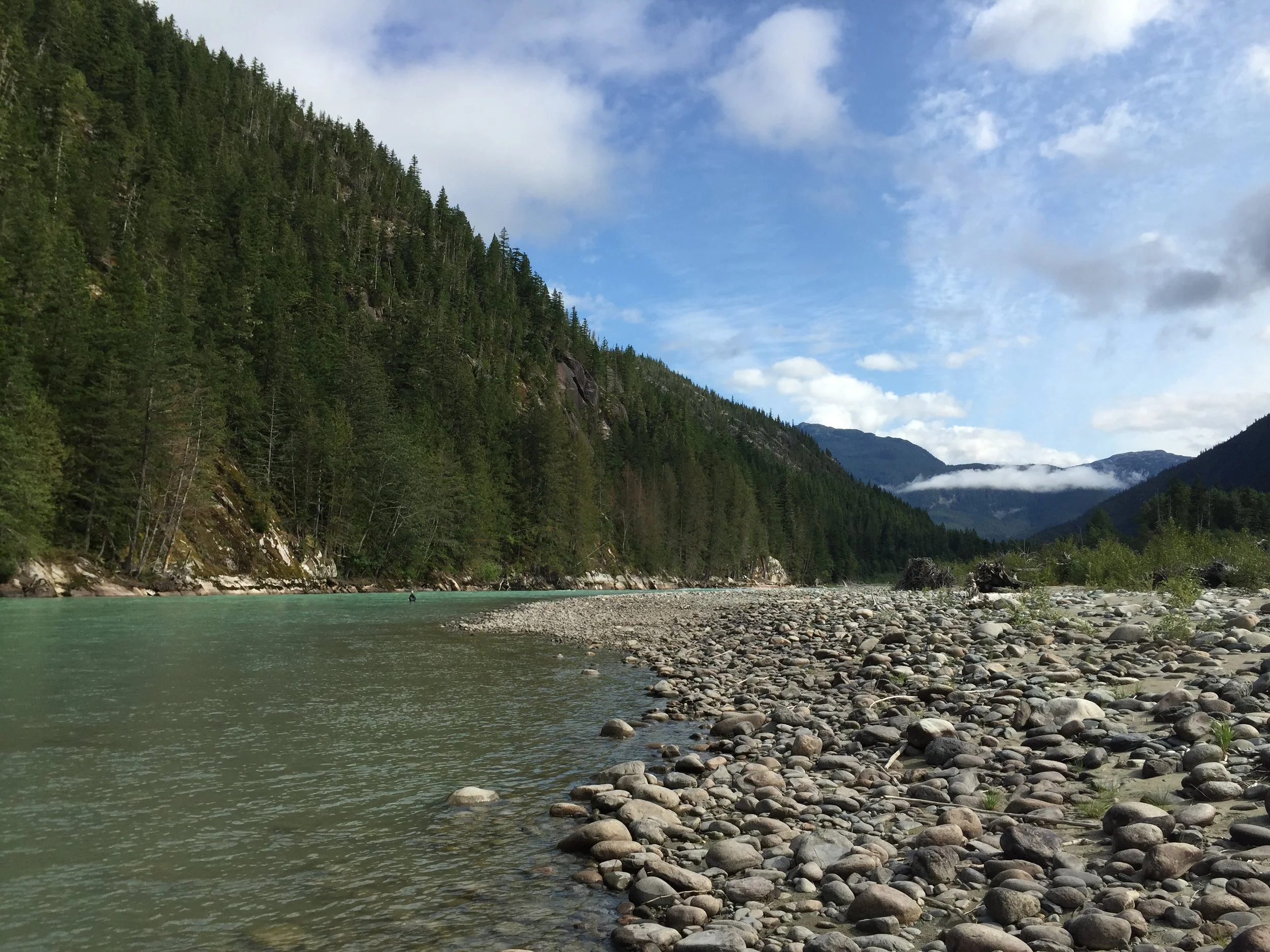
Before me lay a gorgeous steelhead run, and each part of it – the head, the riffle, the bucket, and lastly, the tailout – looked to be the best part. Depending on where my eyes focused, that was where I wanted to be fishing, and the shallow, soft inside told me that I could easily wade, and fish, the entirety of it.
And so I did.
As it turned out, the tailout was the best part of the run – for me, on that day, at that time, with that fly, that tactic and technique, given what I knew and knew how to do, anyway. That was where I encountered not one, but two wild steelhead.
One of those two was so big that, for a moment, I wished that I had some sort of measuring device. Such a desire does not come often for me, but it happened then because just that morning, I’d been eyeing the large chalk board in the dining room at the lodge where I was staying. Painted on that chalk board was a colorful, meticulous, and mesmerizing map of the river we were fishing, including the names of many of the runs and holes where we had been, or were to fish. Next to some of those named pools, in chalk, were the names of lodge guests who had caught steelhead there over a certain length that season. I can’t remember the length specifically, but it was above average; 36 inches, perhaps. I can be a sucker and glutton for competition at times – especially when it’s in my face – so it’s no wonder that my mind returned to this chalk board as I tailed that first, great fish.
But when I hooked the second steelhead in that same tailout, my joy faded towards guilt for, across the river, fishing the same tailout, was my good friend. And while he had not just hooked and landed two great steelhead, he had plainly witnessed me doing so.
Our guide returned to the pool in the boat while I brought the second one to hand (the fishing program at that lodge is for three anglers to fish with one guide, which means the guide sometimes acts as much as taxi service, jetting guests between pools). Unsurprisingly, he came to my side of the river first, and after we released the fish, I gave him the run-down of the recent events.
Then, I pointed to my friend on the other side of the river, still fishing and encounter-less.
“Let’s pick him up and bring him over here,” I said. “He should fish the rest of this tailout.”
The guide just shook his head.
“That never works.”
His theory was that there are too many mental elements in play for a second angler to be successful in the same way that a first has been.
To elaborate: the guide’s belief was that the second angler wouldn’t fish the run or the spot as well, or well enough, because they not fished the entirety of the run; they hadn’t learned (consciously or unconsciously) how the run fishes, and hadn’t been adjusting their presentations accordingly while working their way through the piece of water like the first, successful angler had. In other words, while it’s certainly possible to move one angler from across the river and place them in the very spot that another angler had been catching, or had just caught a fish, the newly-placed angler wouldn’t know what to do (in a very specific sense) when they were placed there.
Additionally, the guide felt that a variation in confidence may also be in consideration. That’s to say, while the first angler’s confidence has been steadily increasing to a high degree – they’ve just caught a fish, or multiple fish, after working the water and experiencing trial and error and then trial and success – the other angler’s confidence is perhaps on an inverse trajectory, which is certainly unhelpful toward fishing well and catching fish.
Taken together, the guide himself had little optimism that moving my friend to my side of the river would result in anything good.
“Just fish it out, and we’ll hope he gets one on that side of the river,” he said, finally. “Then we’ll all go somewhere else.”
And we did.
—
As is often the case with my fishing and reflections thereon, anecdotes such as this find their way into my brain and seemingly remain there in wait for their moment of recall, which can happen on or off the water at any point in the future – days, weeks, or even years later…
—
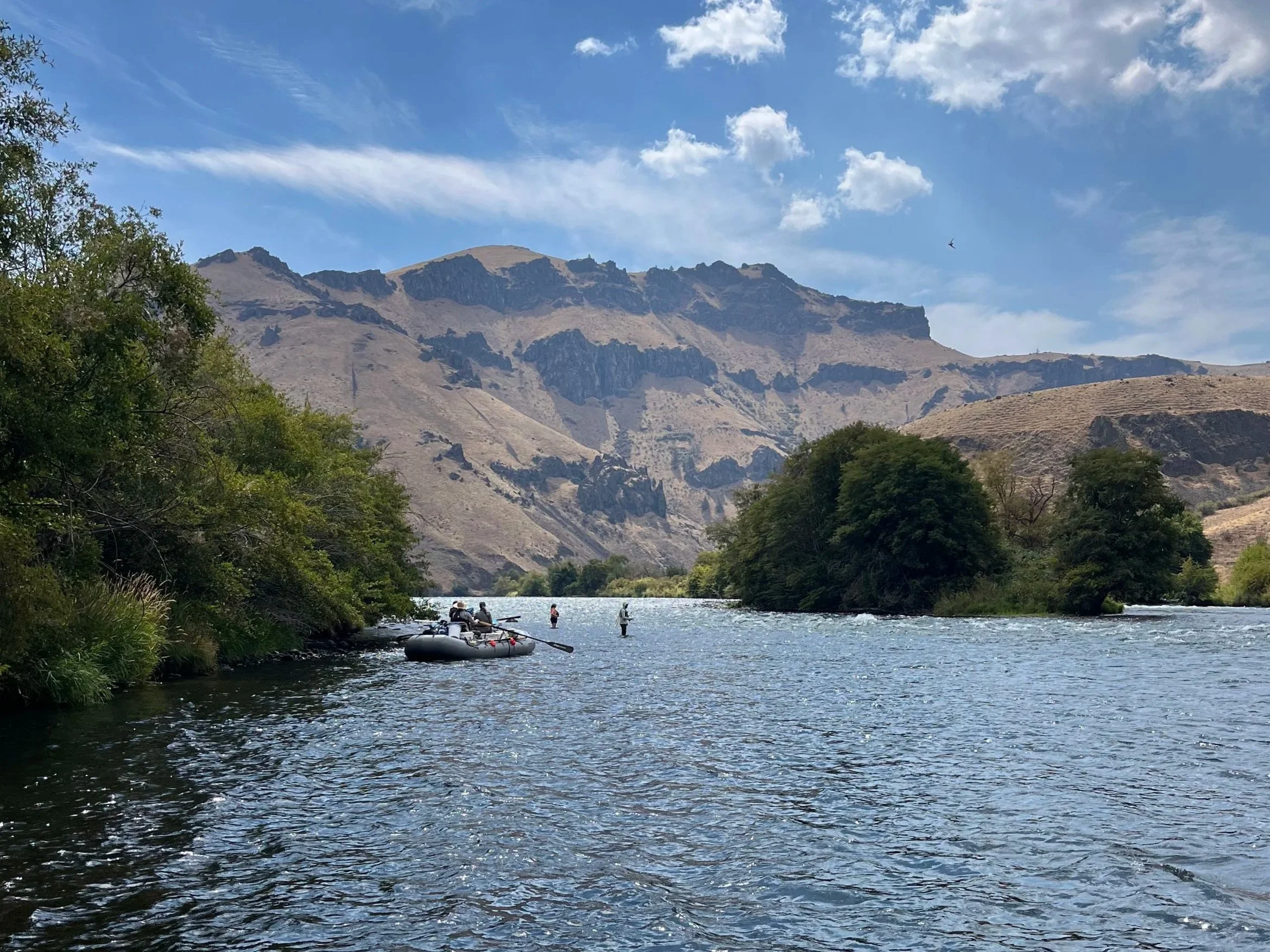
A few weekends ago, seven of us held true to our promises and plans made six months’ prior, and went for a four-day river float, accompanied by trout rods, among many other items. In the absence of consistently-rising trout, we ended up fishing various subsurface, nymphing rigs and systems, each of us employing a version to our liking. They all seemed to hook fish, which is probably good fodder for another rumination, or maybe a better ‘indicator’ that the fishing was just that good. Still, they weren’t everywhere and we didn’t catch them on every cast, but we had so much water at our disposal that we didn’t fret much, or at all, if one spot or another left us fishless.
One day, while floating between camps, in one of the countless, classic trout riffles on the river, three of us spread out over a hundred yards or so of river and deployed our chosen nymphing techniques. Of the three anglers, one – the most downstream – hooked fish after fish, while the other two – which included me – hooked none after none.
Figuring that I’d fished my section of the run well enough, at least with the flies I had tied on, and being unmotivated (or possibly too lazy) to change them as I’d been catching fish on those flies, I returned to my raft. I sat on the side of the boat, and watched the most downstream angler fish. Soon they hooked another rainbow trout.
“You’re up!” they said to me, holding out the rod with which they’d just hooked a half-dozen or more.
I tried to shrug off the offer, but soon found myself in that very spot, with the very rod and flies my friend had been fishing. Just then, that steelhead guide’s philosophy and that moment of steelheading across the river from my friend returned to my mind. I took an inventory of my thoughts and feelings: confidence eluded me, and I was even a little sour about the whole enterprise. My mind was playing tricks on me, even though I was catching it in the act!
Why had I no confidence? Why was I upset? Was that steelhead guide correct? Was I manifesting his theory? Or something else?
A possible reason for the lack of confidence was in the flies and method I was now using; despite my recent witness to their effectiveness, they simply weren’t what I would’ve chosen personally. And, despite evidence of numerous, feeding fish in the area, I had skepticism that there would be even more or that they wouldn’t be wise to the jig by now. There may be a little logic in these theses, but if so, it wouldn’t be bullet-proof.
And what about the bad attitude? Why should I be disgruntled about being offered a position of advantage, a place and method proven to catch trout; the thing that I was trying to do?! I’m reminded of a passage from C.S. Lewis’ Mere Christianity:
If I am drowning in a rapid river, a man who still has one foot on the bank may give me a hand which saves my life. Ought I to shout back (between my gasps) ‘No, it's not fair! You have an advantage! You're keeping one foot on the bank?’ That advantage — call it 'unfair' if you like — is the only reason why he can be of any use to me. To what will you look for help if you will not look to that which is stronger than yourself?
I appreciate Lewis’ analogy, but we’re not talking about drowning; we’re talking about fly fishing, a constant exercise in learning. So another possible aspect is that there is greater value in a process, rather than a conclusion; more reward in playing the game, rather than winning it. In processes and in playing, there are errors and there are losses, but if a solution or a victory is simply presented, its worth is diminished; if the learning process is refused or withheld, something valuable is undeniably lost. Here, I believe we do find some logic, except in that if we submit to the ‘learning process,’ we must do so wholeheartedly and can’t fault it for a non-linear path; we can’t always decide how, when, or in what order, we will learn something.
But even if the flies weren’t ones I chose, and even if I didn’t labor and learn over their decision and how to fish them, why should I still not marvel at my friend’s success and at the magnificence of the trout and the river?! Instead of diminishing confidence following a friend’s success in locating fish, why not increased optimism that there are even more fish, and happy, feeding ones at that?! Why not happily accept the gift of knowledge (and likely, success) from a friend?
Here, I submit to my ego’s effects. When simply outfished (or perhaps better stated, skunked!), the ego-angler is left with unfulfilled, short-sighted desires. They are upset, offended, and feel wronged. And, when the ego is at play, the concept of the valuable learning process is quickly, completely forgotten! Robert Pirsig speaks to this in mountain climbing in his classic, Zen and the Art of Motorcycle Maintenance:
The ego-climber is like an instrument that's out of adjustment. He puts his foot down an instant too soon or too late. He's likely to miss a beautiful passage of sunlight through the trees. He goes on when the sloppiness of his step shows he's tired. He rests at odd times. He looks up the trail trying to see what's ahead even when he knows what's ahead because he just looked a second before. He goes too fast or too slow for the conditions and when he talks his talk is forever about somewhere else, something else. He's here but he's not here. He rejects the here, is unhappy with it, wants to be farther up the trail but when he gets there will be just as unhappy because then it will be "here." What he's looking for, what he wants, is all around him, but he doesn't want that because it is all around him. Every step's an effort, both physically and spiritually, because he imagines his goal to be external and distant.
To the steelhead guide’s initial point about a second angler not knowing what to do in a very specific sense, I understood it plainly: while I had seen my friend hooking numerous fish while standing in roughly the same place, I hadn’t noticed exactly where his drifts were, or how he’d presented the flies. While I was certainly experienced in fishing his chosen rig, I hadn’t experienced his process of trial and success in this spot, so I was only guessing.
Another possible explanation may not be one at all: my friend caught some fish, and I didn’t. Regardless, we kept fishing and enjoyed ourselves all the same. Finally, I shook free of the ego-angler, listened to my friend, and focused on the water. It’s not hard to guess what happened next.
Here, I’m reminded of another fishing friend’s response to another recent analysis of mine. He quoted his teenaged boys in saying, “It’s just not that deep, bro.”
I had no choice but to laugh at myself when that line was laid on me, but I also knew it wouldn’t change my thinking.
